
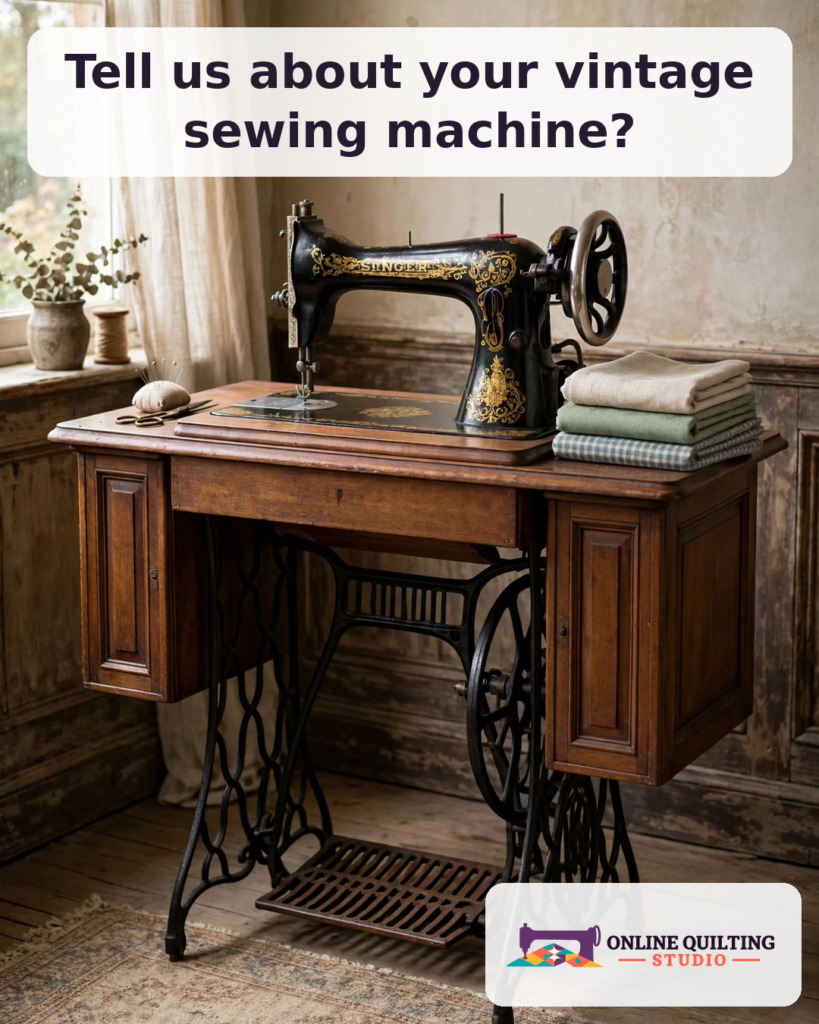
If you’ve ever sat at a treadle sewing machine, you know the feeling. Your feet find the rhythm, the big wheel turns, the needle moves up and down, and suddenly you’re sewing without ever touching a power switch.
No buzzing. No screen telling you what to do. Just you, the fabric, and a machine that’s probably older than everyone in the room — and still doing its job.
It’s a simple, beautiful piece of engineering. It also took a lot of inventors, a few court battles, and more than a century to get there. This is Part 1 of our little series on vintage sewing machines — the overview, the big story. We’ll dig into the details in the next few posts, one machine mystery at a time.
It started with a needle that didn’t work like a hand
For thousands of years, sewing was done by hand, one stitch at a time. The idea of a machine that could do it faster goes back to at least 1790, when English cabinetmaker Thomas Saint patented a design for stitching leather.
Over the next few decades, inventors kept trying. In 1830, French tailor Barthélemy Thimonnier patented a machine that used a hooked needle to make a chain stitch — and it actually worked. It was powered by a foot treadle, much like the machines we picture today.
But none of those early machines really caught on. They were fragile, hard to use, or too expensive to make in large numbers. Good idea, wrong moment — that happens a lot in this story.
Elias Howe and the lockstitch
The turning point came in the United States in 1846, when Elias Howe of Massachusetts received a patent for his sewing machine.
Howe’s big idea was the lockstitch. Instead of trying to copy the motion of a hand, he used two threads — one through a needle with the eye at its point, and one carried by a shuttle underneath. The two threads locked together inside the fabric, making a strong, even stitch.
It was a clever solution. It was also, honestly, a bit of a headache for Howe himself. He spent years defending his patent instead of building a business around it. He had the idea. He just didn’t quite have the timing — or the salesmanship.
Isaac Singer and the treadle that changed everything
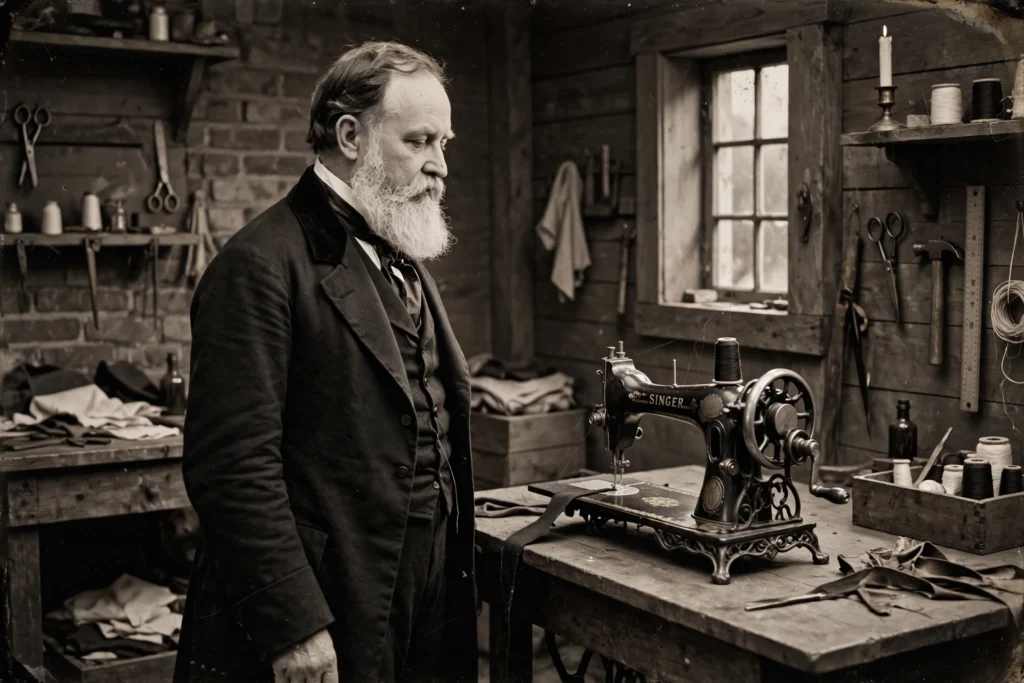
That’s where Isaac Merritt Singer comes in. Singer didn’t invent the sewing machine, but he made it practical — and he made it a household name.
In 1851, Singer patented his own version, with a needle that moved straight up and down, a flat table to support the cloth, and a presser foot to hold the fabric in place. Most importantly for home sewers, his machine was powered by a foot treadle, leaving both hands free to guide the fabric.
The Smithsonian notes that Singer’s success wasn’t just about the invention itself — it was also about how the company sold it, demonstrated it in homes, and made it feel like something ordinary families could learn to use.
In other words, Singer wasn’t only a better machine. It was a better story. And people bought the story, then learned to love the machine.
The sewing machine war — and the first patent pool
Singer’s machine used Howe’s lockstitch, and Howe sued him for patent infringement — and won, in 1854.
The lawsuits that followed involved several manufacturers, including Howe, Singer, Wheeler & Wilson, and Grover & Baker. If you think quilters can be passionate about their machines, you should have seen these gentlemen in court.
In 1856, they finally settled it by forming what became known as the Sewing Machine Combination — the first patent pool in U.S. history. The companies pooled their patents and shared the earnings, instead of suing each other over every machine.
Once the legal fights settled down, production took off. Singer was making about 2,500 machines in 1856, and by 1882 the company had sold around 800,000. By the early 1900s, Singer machines were in homes all over the world.
It’s funny, when you think about it. The machine that was supposed to save time spent its first decade mostly in court.
From factory floor to the family home
At first, sewing machines were mostly for factories and tailors. But by the 1860s, they were moving into homes, too.
Singer started selling machines in wooden cabinets, so the machine became a piece of furniture — something that belonged in the parlor, not just the workshop. The treadle machines of the late 1800s and early 1900s, with their ornate black metal, gold decals, and cast-iron bases, are the ones many of us recognize today.
The first electric machines arrived in 1889, also from Singer, but treadle and hand-crank machines stayed common for decades. Treadle machines were still being made into the 1950s, and they were most common in the late Victorian years.
Somewhere along the way, the sewing machine stopped being just a tool and started being part of the house — and part of the family.
Why vintage machines still have a place in quilting
So why do quilters still love these old machines?
Part of it is the way they sew. A well-kept treadle machine makes a steady, even stitch, and it’s wonderfully quiet compared to a modern machine — just the soft rhythm of the treadle and the needle. It slows you down in the best way. You can actually hear yourself think.
Part of it is the history. Many vintage machines were passed down from a mother, a grandmother, or an aunt. They carry stories with them, and sewing on one can feel like sewing alongside the person who used it before you. You find yourself wondering what they made on it, and who they made it for.
And part of it is simply that they were built to last. With cast iron, steel, and solid wood, a machine made a hundred years ago can still sew today, if it’s been looked after. That’s a humbling thought, in a world where so much is made to be replaced.
You don’t need a vintage machine to make a beautiful quilt, of course. But if you have one, you know — it’s more than a tool. It’s a connection.
What’s coming next
This was the overview — the short version of a very long story. In the next posts in this series, we’ll slow down and look closer:
- Part 2 — the Singer treadle up close: how it actually works, and why it still sews so well
- Part 3 — how to date your vintage machine, using serial numbers, decals, and other little clues
- Part 4 — bringing one back to life: cleaning, oiling, and knowing when to get help
- Part 5 — the stories they carry: machines passed down, found, and rescued — including stories from readers like you
We’d love for you to come back for those. Follow Online Quilting Studio on Facebook, and we’ll let you know there when the next one posts.
And in the meantime — do you have a vintage sewing machine? Tell us how you got it. Was it passed down, found at a thrift shop or an estate sale, or rescued and brought back to life? Share your story in the comments. We’d love to hear it.
onlinequiltingstudio.com