
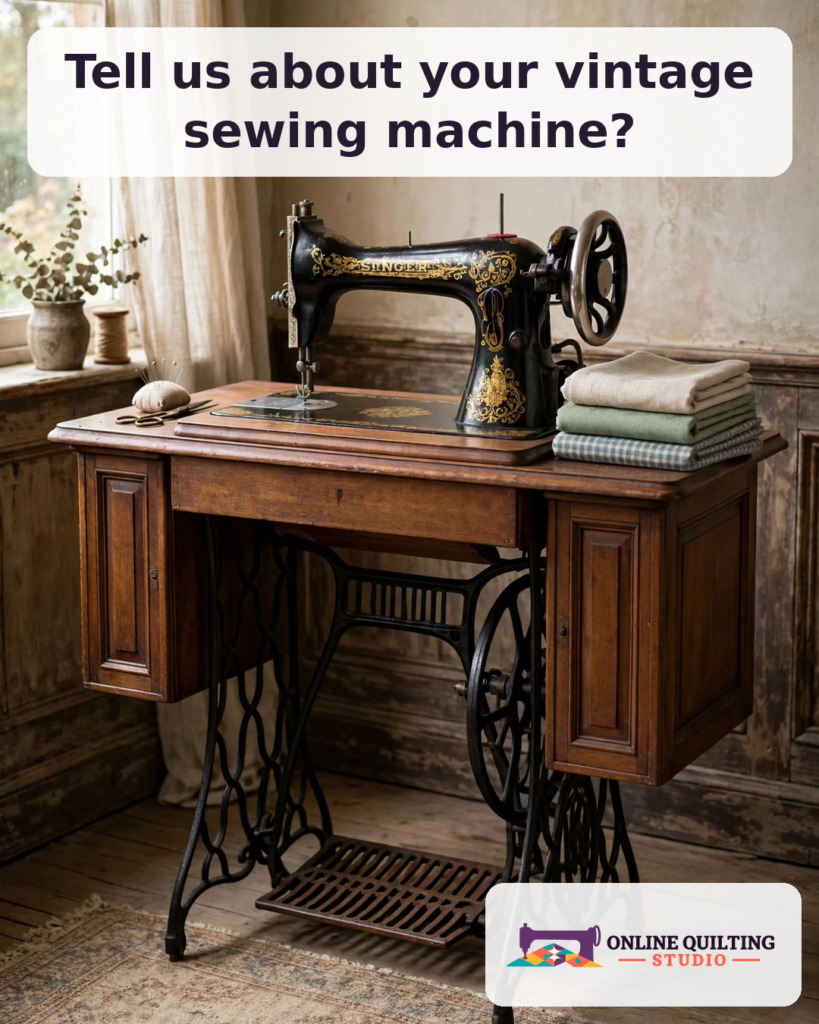
In Part 1, we met the inventors. In Part 2, we looked inside the machine and learned how a treadle actually sews. This time, we’re going to play detective.
Because almost everyone who ends up with a vintage machine asks the same question, usually within about five minutes of bringing it home: how old is this thing?
Sometimes there’s a family story to go with it — “Grandma got it when she married in 1912.” Sometimes there’s no story at all, just a beautiful black machine in a wooden cabinet and a lot of curiosity.
The good news is that your machine is leaving you clues. The serial number, the decals, the shape of the bobbin underneath, even the cabinet it’s sitting in — they all say something about when it was made. The trick is knowing which clue to trust, and which one is lying to you with a straight face.
You don’t need to be a collector, and you don’t need to take anything apart. And you’re not usually going to find an exact birthday — a year, sometimes a range of years, and a factory is a perfectly good answer.
Start with the serial number
Every Singer has a serial number — except the little toy machines — and it’s stamped right into the metal, not printed on a paper label that could fall off. Singer stamped the number in for its own factory records, and those records, in large part, survived.
On most older machines, look on the bed — the flat part where you sew — usually on the front edge, to the right of the needle plate, or near the base of the pillar. On later machines, you may need to look underneath the bed. Take your time. The numbers can be worn, or filled in with a century of lint and oil.
A few things that are not the serial number, and this is where most people go wrong. The number on the motor is not the serial number — that’s the motor’s own number, and it will not date the machine. The model number is not the serial number, either. A model number like 66 or 15 is short, and it tells you what kind of machine it is. The serial number is long, and it tells you when this particular machine was made. A 66 is not made in 1966, and a 15 is not made in 1915. And the number on the bobbin plate, the foot pedal, or a random part is not the serial number — those are part numbers. If there are several numbers, use the longest one.
The shape of the serial number already tells you something. Numbers only, no letters — usually before about 1900, since Singer didn’t start using letter prefixes until around then. One letter followed by numbers — from about 1900 onward, something like G1234567. Two letters followed by numbers — from 1924 onward, something like AF338121.
Write the whole thing down exactly as it appears, letters and all, and take a clear photograph of it. And be gentle while you’re looking. Don’t scrape at the numbers with anything sharp. A soft cloth is enough. We’ll talk properly about cleaning in Part 4.
Look it up — and read the answer the right way
Once you have the serial number, the most reliable place to look it up is the free database kept by the International Sewing Machine Collectors’ Society — ISMACS for short. Their Singer serial number tables are taken from Singer’s own publications, and they cover, as far as the surviving records allow, machines from the 1850s through to 1971.
You find the page for your letter prefix (or the no-prefix page, if your machine is pre-1900), find the range your number falls into, and the table tells you the model and the date that block of numbers was allotted.
That word, allotted, matters. The date in the ISMACS tables is the date Singer allotted that block of serial numbers to a factory to be built — not the exact day your particular machine rolled off the line. The machine itself usually followed within months. ISMACS says it plainly on their own pages: the dates are when the serial numbers were allotted, not the actual date of manufacture.
So read the answer as “around this year,” not as a precise birthday. If the table says your serial was allotted in 1912, then your machine was made around 1912 — probably in 1912, possibly early 1913.
The letter prefix can also tell you something about where it was made. The sources agree on the two big ones: machines with a G prefix were made at Singer’s Elizabethport factory in New Jersey, and machines with a D prefix were made at Kilbowie, in Clydebank, Scotland. But the prefix alone won’t give you the year — that’s what the full number and the table are for. And if two sources disagree about a rarer prefix, trust the ISMACS table for your exact number.
Not all of Singer’s records survived, so not every machine can be dated precisely — a range like “1910 to 1912” is still a real answer. And the lookup won’t tell you when the machine was bought. A machine made in 1912 might have been sold in 1915. The serial dates the making. The family story dates the buying.
The patent-date trap
Now for the clue you should not trust — and it’s the one most people trust first, because it’s right there in front of them, stamped into the metal in plain English.
Open the little slide plate beside the needle, and you’ll often find a row of dates stamped on it: DEC 11 1900, MAR 5 1901, JUL 23 1901, and so on. They look like a build date. They are not a build date.
Those are patent dates — the dates of the patents covering the parts in that machine. The machine can’t be older than the latest patent date on it, but it could be much, much newer. A machine with a patent date of 1901 on its slide plate could have been made in 1912, or 1920, or later.
One owner, quoted on a collectors’ forum, had a machine with a sales receipt from 1915 and a slide plate carrying a patent date of June 14, 1910 — and was trying to work out whether the machine was made in January 1910. It wasn’t, or at least, the patent date couldn’t tell them that. The serial number was the way to date it, and the slide plate may well have been a replacement part anyway.
So here’s the rule, and it’s worth writing on a sticky note: the latest patent date on the machine is the earliest the machine could have been made — and nothing more.
What the decals are telling you
If the serial number is the machine’s birth certificate, the decals are its clothes — and clothes, as any quilter knows, say a lot about when something was made.
The decals are the gold scrollwork and pictures decorating the black body of the machine. Singer never officially gave them names. The names collectors use — Sphinx, Red Eye, Lotus — were invented by collectors afterwards, because they needed a way to talk about them.
- Sphinx, also called Memphis (roughly the 1890s to the 1950s). Egyptian designs — sphinxes, palm leaves, pyramids — in gold on black. Most often seen on the Model 27 and its later version, the 127.
- Red Eye (early 1900s to the 1920s). Floral scrollwork with two red, eye-shaped designs on either side of the Singer name on the arm. It’s very closely associated with the Model 66 — so closely that a Model 66 with Red Eye decals is often just called a “Red Eye.” In America, the Red Eye pattern was introduced around 1910. In Britain, the same Model 66 wore different decals — the Lotus pattern, and later the Sphinx — so a British 66 won’t have red eyes at all, and that’s normal.
- Lotus. A petal pattern, used on British-made machines, including the Model 66 made at Kilbowie.
- Later, plainer decals. After the 1950s, Singer started using much simpler patterns. So if your machine is mostly plain black with very little gold on it, that’s a clue in itself: it’s probably a later machine.
A few cautions. Decals wear — faint decals often just mean a machine was loved harder, not that it’s older. Decals get repainted and replaced, too, so if they look too crisp or slightly off-centre, they may not be original. And the same decal set was used for a long time, so decals can narrow things down — “early 1900s, probably a 27” — but they can’t give you a year. That’s the serial number’s job.
The model number, and the bobbin underneath
Singer rarely printed the model number on the machine. But you can work the model out from the machine itself, and the best clue is usually underneath — the bobbin. Slide open the plate beside the needle and look at what you find there, just as we did in Part 2. A long, boat-shaped shuttle that slides back and forth — a vibrating shuttle — points to the 27, 28, 127 or 128 family. A round bobbin in a shuttle that turns in a circle — a rotary or oscillating shuttle — points to later models like the 66 and the 15. The 66 is the Red Eye machine; the 15 is the workhorse that Singer made, in various forms, from 1879 onwards.
The size helps too: a full-size machine is a different animal from a little three-quarter-size portable like the 99, essentially a smaller 66, or the Featherweight 221, smaller still.
None of this replaces the serial number. But it lets you check the serial number’s answer. If the ISMACS table says your machine is a 66, and you open it up and find a round rotary bobbin, those two clues agree. If the table says 66 and you find a long vibrating shuttle, it’s worth double-checking that you copied the serial number correctly, or that the machine hasn’t had parts swapped over the years.
The cabinet, the motor, and the other clues
The machine head is the part that matters most for dating, but the things around it can help — as long as you remember that they’re the least reliable clues, not the most.
The early treadle cabinets, from the 1880s to the 1920s, were often heavy oak or walnut, with a cast-iron treadle base — the classic parlor cabinet, sometimes with a domed “coffin top” that covered the machine. Later cabinets, from the 1920s and 30s, were often simpler — a drop-head cabinet, where the machine pivots down and the top closes flush.
But the cabinet and the machine head are not necessarily the same age. A machine head can be moved from one cabinet to another, and very often was. And the number stamped on the cabinet, if there is one, is the cabinet’s number, not the machine’s. If the cabinet looks 1920s and the serial says 1912, both can be true. The machine is 1912. The cabinet is 1920s. They just met later in life.
Many treadle machines were converted to electric later in life. A motor bolted onto the back of a treadle head is very often a later addition — sometimes decades later. It dates the conversion, not the machine.
The little Singer badge changed over the years too — early badges, from roughly 1875 to 1885, read “The Singer Manufacturing Co. New York”; after that, “New York” was dropped.
When the clues disagree
Trust them in this order: first, the serial number, looked up in the ISMACS tables. Second, the model, from the bobbin and the shape of the machine. Third, the decals. Fourth, the cabinet, the motor, and the badge — useful context, but the least reliable, because all of them can be swapped, added, or replaced without touching the machine head.
If the serial says 1912 and the decals say “early 1900s, Model 66,” and the cabinet looks 1920s, and there’s a motor bolted on the back — that’s not a contradiction. That’s a machine that was made in 1912, dressed in the decals of its era, put in a later cabinet, and electrified at some point afterwards. That’s a perfectly ordinary life for a hundred-year-old machine.
And if, after all that, you still can’t pin it down — if the records have a gap, or the serial is worn away — then “probably early 1900s, Model 66 family, from the decals and the bobbin” is still a real answer. You don’t need a precise year to love a machine, or to sew on it.
Your detective checklist
- Write down the serial number. Look on the bed, to the right of the needle plate, or on the front of the base, or underneath. Write it exactly, letters and all. Photograph it.
- Check what it isn’t. Not the motor number, not the model number, not a part number. If there are several numbers, use the longest.
- Look it up in the ISMACS Singer serial number database. Find your prefix page, find the range your number falls in, and note the model and the allotment date. Remember: allotment date, not exact manufacture date. Think “around this year.”
- Read the patent dates — then set them aside. The latest patent date is the earliest the machine could have been made. It is not the build date.
- Look at the decals. Sphinx? Red Eye? Lotus? Plain? Note what you see, and whether it fits the model and era the serial suggests.
- Open the bobbin area. Long boat-shaped shuttle, or round rotary bobbin? That tells you the family — 27/28, or 66/15.
- Look at the cabinet and the motor. Note the style, and whether the motor looks original or added later.
- Write it all down. Serial, model, allotment year, factory if the table gives it, decals, bobbin type, cabinet style. Keep it with the machine. The next person who wonders about this machine will be very glad you did.
What’s coming next
Next time, in Part 4, we’ll get our hands dirty — bringing one back to life: cleaning, oiling, and knowing when to get help, and when to leave well alone.
After that, in Part 5, the stories these machines carry — machines passed down, found, and rescued — including stories from readers like you.
We’d love for you to come back for those. Follow Online Quilting Studio on Facebook, and we’ll let you know there when the next one posts.
And in the meantime — did you date your machine? What did the serial number say, and did the decals agree with it? Tell us in the comments. Was it older than you thought, or younger? Was it made in New Jersey, or in Scotland? Share your machine’s story — and its year, if you found one. We’d love to hear it.
onlinequiltingstudio.com